- OBJECTS
- 12
- SPAN
- 2008—2026
- SHORTEST
- 1.8h
- LONGEST
- 21h
- SMALLEST
- 0.4m
- METEORITES
- 4found
IMMINENT IMPACTORS · 2008 — 2026
Found before they fell. Just twelve.
From October 2008 to May 2026, twelve asteroids were discovered before they plunged into the Earth’s atmosphere. The first was 2008 TC3. Eighteen years later, that is still all there are. And the observations of all twelve remain at the Minor Planet Center. OrbitLife can download them directly, so you can compute all twelve with your own hands.
The screenshots on this page were taken with the Japanese edition. The English edition shows the same screens with English labels.
The twelve.
“Warning” is the time from discovery to atmospheric entry. The shortest was 1.8 hours. To find the object, determine its orbit and work out where it would fall — that was all the time anyone had.
| Object | Entry (UTC) | Where it fell | Diameter | Warning | Meteorites recovered |
|---|---|---|---|---|---|
| 2008 TC3 | 2008-10-07 02:46 | Northern Sudan | 4.1 m | ~20 h | Almahata Sitta |
| 2014 AA | 2014-01-02 03:04 | Central Atlantic Ocean | 1.6–3.9 m | ~21 h | — |
| 2018 LA | 2018-06-02 16:45 | Botswana–South Africa border | 2.7 m | ~8.5 h | Motopi Pan |
| 2019 MO | 2019-06-22 21:26 | Caribbean Sea | 5.3–7.2 m | ~13.5 h | — |
| 2022 EB5 | 2022-03-11 21:22 | Arctic Ocean | 4.2–5.7 m | ~2 h | — |
| 2022 WJ1 | 2022-11-19 08:26 | Ontario, Canada | 0.5–1.2 m | ~3.6 h | — |
| 2023 CX1 | 2023-02-13 02:59 | English Channel | 0.7 m | ~6.7 h | Saint-Pierre-le-Viger |
| 2024 BX1 | 2024-01-21 00:32 | Near Berlin, Germany | 0.4 m | ~2.7 h | Ribbeck |
| 2024 RW1 | 2024-09-04 16:39 | Northern Luzon, Philippines | 1.5–2.0 m | ~10.9 h | — |
| 2024 UQ | 2024-10-22 10:54 | Eastern Pacific Ocean | 1.2–1.5 m | ~1.8 h | — |
| 2024 XA1 | 2024-12-03 16:14 | Eastern Siberia | 0.6–1.6 m | ~10.3 h | — |
| 2026 JN4 | 2026-05-15 13:39 | Arafura Sea, northern Australia | 0.5–1.2 m | ~5.5 h | — |
Every diameter is a matter of meters. The smallest, 2024 BX1, was just 0.4 m — a stone that would fit on a desk, spotted out in space 2.7 hours before it hit the Earth.
About the twelfth, 2026 JN4
It was discovered on May 15, 2026, by N. Saini with the JPL SynTrack Robotic Telescope (temporary designation ST26E86). The entry itself, however, has never been confirmed — according to the International Meteor Organization, there are no eyewitness reports and no radio, radar or infrasound records. Sources also differ in how they describe where it fell. A textbook case that “predicted” and “observed” are not the same thing.
Please, try them yourself.
This page gives no step-by-step instructions. That would spoil the best part. The impact computation page walks through the whole procedure once, with 2008 TC3. The same steps work as they are for the other eleven.
FIRST
No hunting for observations
Choose [File] → [Get Observations from MPC], type a name such as 2018 LA into the Object field, and press [Get]. That’s all. Every observation reported to the MPC is downloaded, saved to your observation folder and loaded on the spot. The list appears within seconds.
No searching websites, no copying and pasting text, no reformatting. There is no point here where you get stuck and give up. The dialog shows C/2025 A1, 2P, 332P and 2024 YR4 as examples. The designations in the table above work exactly as written.
NEXT
Where to start
THEN
Check your answer against the table
Compare the entry time you get with “Entry (UTC)” in the table. Look up the latitude and longitude of the impact point on a map. The feeling when it matches to the minute is, I suspect, hard to put into words.
When it doesn’t match — and when it does
When it doesn’t match, suspect your own procedure first: the choice of three observations, the rejection threshold,
whether the improvement has fully converged. Did you press [Impact Prob.] while σ0 was still large
(Impact computation, §04)?
When it does, part of the reason is that you are computing after every observation is in.
The observers on the day of discovery had to judge with only a small fraction of the data you now have.
Getting the same numbers does not mean you have reproduced how hard it was.
The twelfth, the day I heard of it.
I decided this page would give no step-by-step instructions. But I allow one exception. The twelfth, 2026 JN4, is an object I learned of only while building this page — “wait, there was one of those?” Here is the record of computing it that same day, left just as it was. It took a few tens of minutes.
1
Six observations, an arc of 2 h 44 min
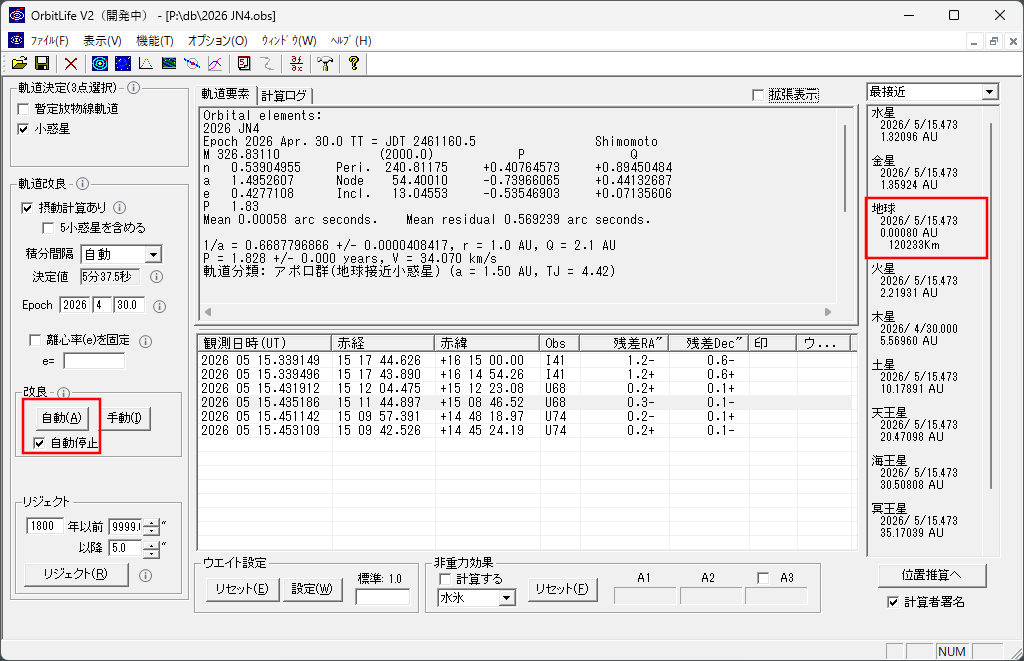
Typing 2026 JN4 into [Get Observations from MPC] brought up just six observations, from May 15.339149 to 15.453109, 2026 — 2 hours 44 minutes. Three observatories: I41, U68 and U74. That was everything.
On this arc, pressing [Manual] only makes the residuals bounce up and down without converging. Check [Auto stop] and press [Auto] — exactly the situation the Tutorial describes as “when there are extremely few observations.” Mean residual 0.569239 arcsec.
2
Move the epoch to May 20.0 and press [Impact Prob.]
I checked [Systematic err.]. Six observations packed into 2 hours 44 minutes is exactly the case where errors that never show in the residuals matter most. The program takes σ0 = 0.805 arcsec, allows 0.5 arcsec for systematic error, and computes with 0.948 arcsec.
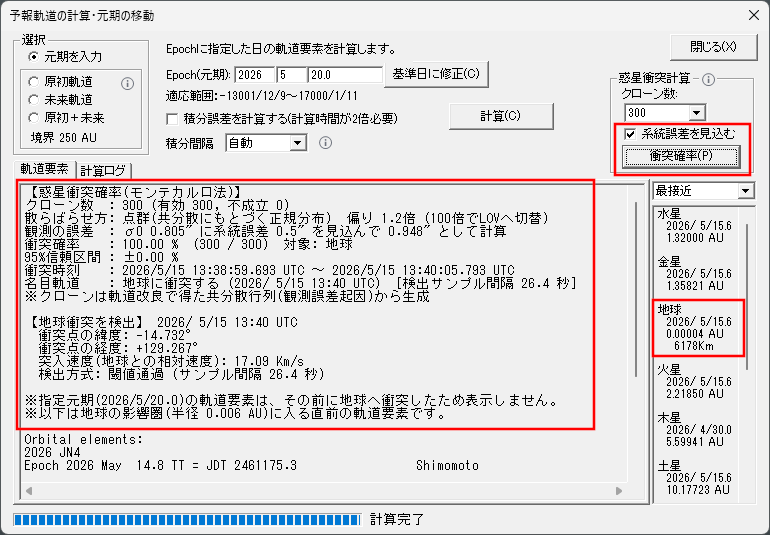
Put it beside 2008 TC3, and the length of the observed arc shows up directly as the spread of the answer.
| 2008 TC3 | 2026 JN4 | |
|---|---|---|
| Observed arc | ~1 day | 2 h 44 min (6 obs.) |
| Mean residual | 1.557716″ | 0.569239″ |
| Uncertainty of 1/a | ±0.0000010943 | ±0.0000408417 |
| Covariance elongation | 3.0× | 1.2× |
| Detection sampling interval | 10.5 s | 26.4 s |
| Spread of the 300 impact times | 0.414 s | 66.1 s |
| Impact probability | 100.00 % | 100.00 % |
The spread in time grew 160-fold. Even so, all 300 clones agree on whether it hits. What a short arc makes uncertain first is when and where.
3
Get its size from the light curve, too
It is an asteroid, so set [Object type] to [Asteroid]. With so few observations, G is fixed at 0.15 (the screen itself says “Few observations: average G = 0.15 recommended”). H = 33.09, RMS 0.172.
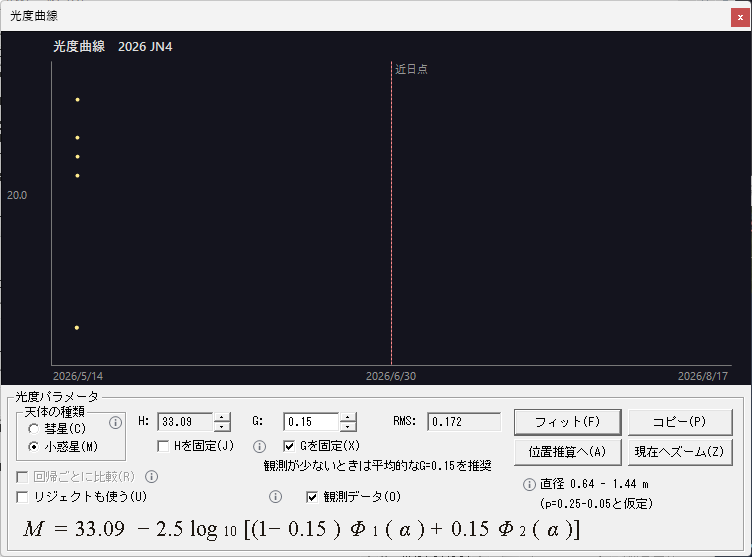
This display was fixed while this page was being written
Diameters had long been shown in kilometers, so at first this line read “0.00 − 0.00 km”. For a meter-class object there simply weren’t enough digits to read. What you see above is after the fix: below 1 km, the diameter is now shown in meters. — After all, asteroids that fall to Earth are usually measured in meters.
4
Checking the answer
| OrbitLife | Published | |
|---|---|---|
| Entry time (UTC) | 2026/5/15 13:40 | 2026/5/15 13:39 |
| Diameter | 0.64 − 1.44 m | 0.5 − 1.2 m |
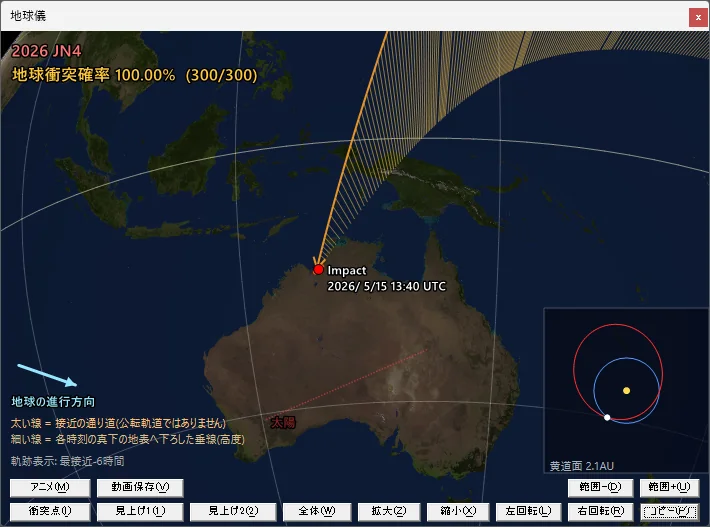
| Location | −14.732°, +129.267° | Arafura Sea, northern Australia |
The forecast came true — and no one saw it
Local time at the entry point was around 22:17. The Moon was 28.4 days old,
1.2 days before new — a dark, moonless night. Not bad conditions at all.
Yet there are no eyewitness reports, and no radio, radar or infrasound records.
Directly beneath the entry point lay an almost uninhabited stretch of coast in northern Australia.
And from a diameter of 0.64–1.44 m and an entry speed of 17.09 km/s, the estimated entry energy is
0.015–0.163 kt (assuming rock). Not enough to be sure of registering on the detection networks.
“The forecast came true” and “it was observed” are two different things.
The twelfth was exactly that kind of case.
— And all it took to get this far was typing a name and pressing [Auto] a few times. When the next one makes the news, try it yourself.
Twelve in eighteen years.
That may seem like very few. After all, far more stones than that fall on the Earth every year. But twelve is not “the number that fell.” It is the number found while still out in space, before they fell.
A one-meter stone 1 million km from the Earth is fainter than magnitude 20. A survey has to catch it, it has to receive a designation, follow-up observations have to come in, an orbit has to be determined, and “it will hit the Earth” has to be established — all within a few hours. Think of twelve as a measure of just how hard that is.
And this number is going to grow. The table shows three in the ten years from 2008 to 2018, and eight in the four years from 2022 to 2026. It has grown as fast as the survey net has tightened. When the next one is reported, its observations will again go to the MPC. When that day comes, compute it yourself — the same day as the news.
Next door.
Computing the Orbit of an Earth Impactor
The full procedure, walked through once with 2008 TC3: impact time, latitude and longitude, entry speed, and the impact probability from 300 clones.
→ Impact computationTutorial
New to orbit computation altogether? Start here. It also covers [Get Observations from MPC].
→ TutorialThe Final Call
Being right once does not guarantee being right next time.
→ The Final CallSources for the list.
The orbital elements, residuals, impact time, impact point, entry speed, impact probability, H and diameter in §03 are all values computed with OrbitLife, exactly as shown on screen (the diameter is a range assuming an albedo p of 0.25–0.05). Everything else — the entry times, locations, diameters, warning times and meteorite names in the §01 table — comes from the following.