- OBJECT
- 2008 TC3
- MEAN RESIDUAL
- 1.5577″
- CLONES
- 300
- P(IMPACT)
- 100.00%
- MIN STEP
- 10.5s
- ENTRY
- 12.78km/s
2008 TC3 · Recomputing an asteroid that fell
When will it hit, and where? To the second and the degree.
2008 TC3 was the first asteroid ever found before it struck, with its impact predicted in advance. About 20 hours after discovery, it plunged into the sky over the Nubian Desert in Sudan. Here we load the actual observations just as they are and follow them, step by step, all the way to the time of impact, its latitude and longitude, the entry speed — and finally the impact probability.
The screenshots on this page were taken with the Japanese edition. The English edition shows the same screens with English labels.
Why the answer can only be a probability.
The orbit computed from the observations is a single line: “this is almost certainly it.” But every observation carries some error, so the true orbit has a slight spread around that line. Integrate decades ahead, and the spread grows far larger than a planet. That is why no one can say flatly “it will hit” or “it will miss” — the only honest answer is a probability.
Impact probability = clones that hit ÷ total number of clones
Zero hits does not mean “no impact”
Even with zero hits, all you have shown is that no impact turned up within what that many clones can resolve. As a rule of thumb, 300 clones can resolve down to 1/300 (about 0.3%), and 3000 clones down to 1/3000 (about 0.03%). If 300 clones give zero hits, all you can say is that the probability is no larger than roughly 0.3%. To rule out anything smaller, you need more clones.
First, solve the orbit as usual.
STEP 1
Load the observations and let the orbit improvement converge
Up to this point, the procedure is exactly the same as for any other object. Once it converges: mean residual 1.557716 arcsec; a = 1.2651889 AU, e = 0.2812245, i = 2°.29630. Classification: Apollo (near-Earth asteroid) · TJ = 5.06.
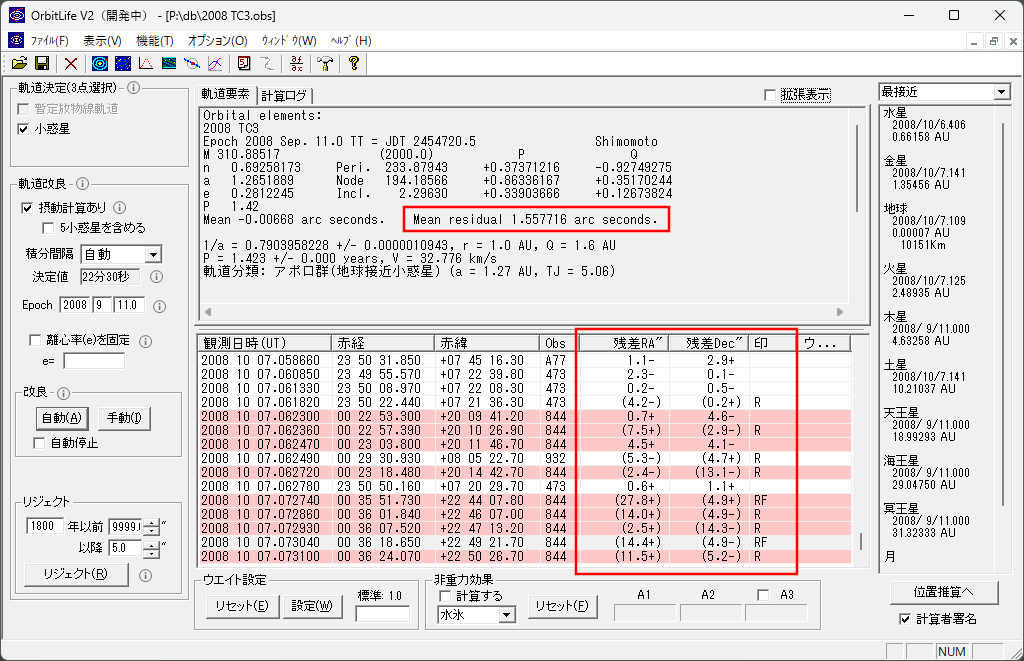
Note the [Used] integration step
In the left column, [Step] is set to [Auto], and the [Used] value below it reads 22 min 30 s. For an ordinary asteroid, steps of a day or more would do; this orbit, though, passes right by the Earth, so the program refines the step on its own. More on this in §06.
Move the epoch past the impact.
A converged orbit alone tells you neither the time nor the place of impact. You have to carry the integration beyond that date and see whether it runs into the Earth on the way. The tool is [Move Epoch of Solution] — the same one used for the minimoons.
STEP 2
Set an epoch beyond the impact and press [Compute]
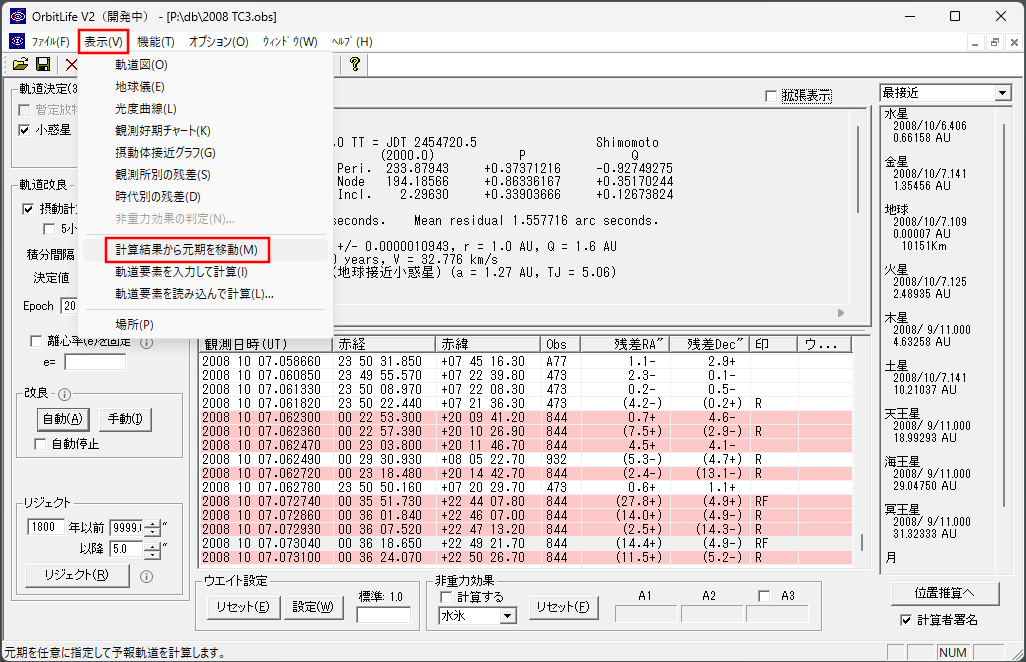
From the menu…
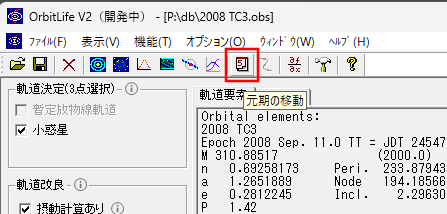
…or from the toolbar button. Same thing.
Enter October 10.0, 2008 as the epoch — three days after the fall — and press [Compute]. The integration never gets there. It hits the Earth on the way and stops.
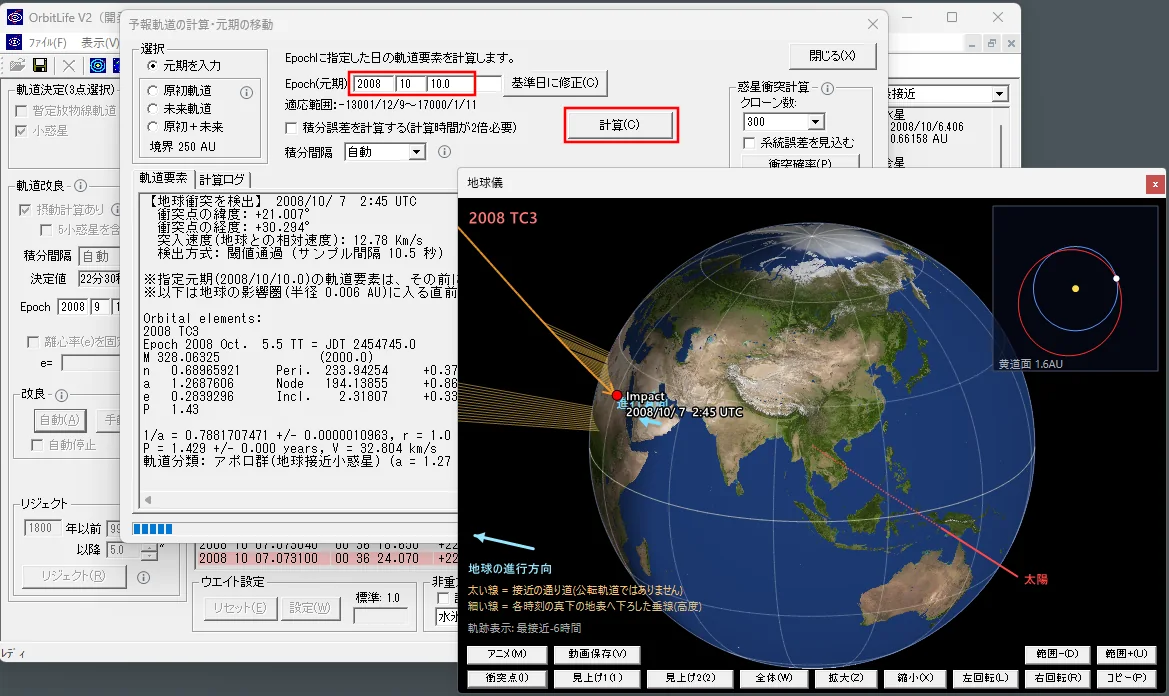
Two notes on the screen
“Elements at the specified epoch are not shown because the object hit Earth before that.”
There are no orbital elements for October 10, 2008. By then, the object was already gone.
“Below are the elements just before entering the sphere of influence of Earth (radius 0.006 AU).”
The sphere of influence is a rough guide to “the region where the planet, not the Sun, should be treated as the central body,”
given by Laplace’s formula r = d · (m/M)2/5. For the Earth it is
0.006180 AU (about 925,000 km). Inside it, heliocentric orbital elements lose their meaning, so the program shows
the elements just before entry.
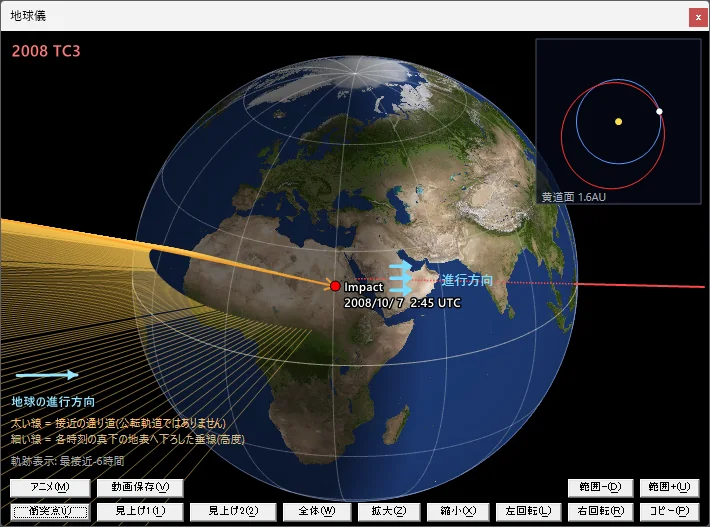
Scatter 300 clones. Then count.
STEP 3
Check [Systematic err.] and press [Impact Prob.]
Leave [Clones] at 300. All 300 converged on the same single point.
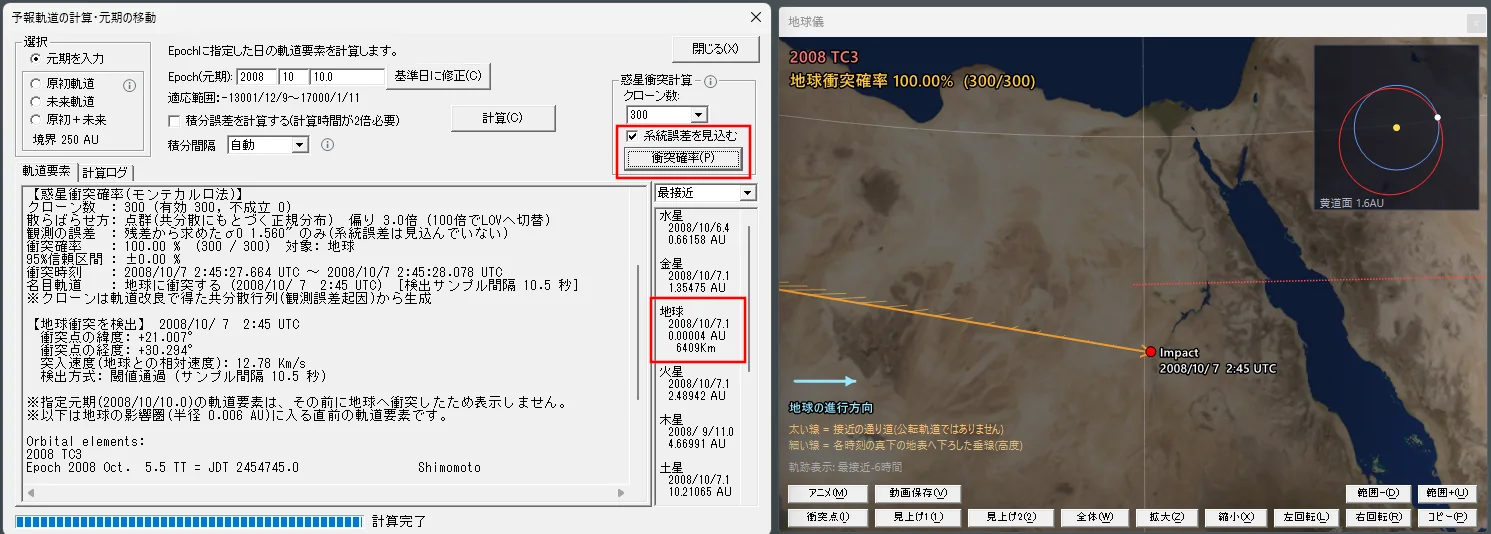
| Log item | Result for 2008 TC3 |
|---|---|
| Clones | 300 (valid 300, failed 0) |
| Sampling | cloud (normal distribution from the covariance), elongation 3.0× |
| Obs. error | σ0 = 1.560″ |
| Impact prob. | 100.00 % (300 / 300) target: Earth |
| 95% CI | ±0.00 % |
| Impact time | 2:45:27.664 — 2:45:28.078 UTC |
| Nominal | hits Earth (2008/10/7 2:45 UTC) |
The impact times of all 300 clones fall within 0.414 seconds. The 95% confidence interval is 1.96√(p(1−p)/n); with p = 1, it is zero.
Sometimes the program itself says “not reliable”
When σ0 exceeds 10 arcsec. The covariance rests on the assumption that, near the solution,
the relation to the observations can be treated as linear. While the orbit still does not fit the observations,
that assumption breaks down, and the covariance is huge and meaningless. Get the orbit improvement to converge first.
When more than 20% of the clones fail. Clones whose randomized elements end up with q < 0 or e < 0
are discarded — but the more are discarded, the less the rest is a fair sample.
It means the ratio can no longer be read as a probability.
Watch the entry on the globe.
STEP 4
Change the view, animate, export
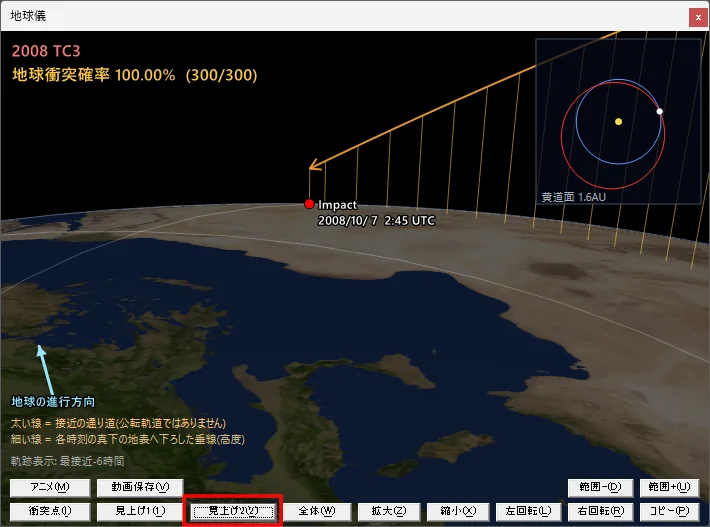
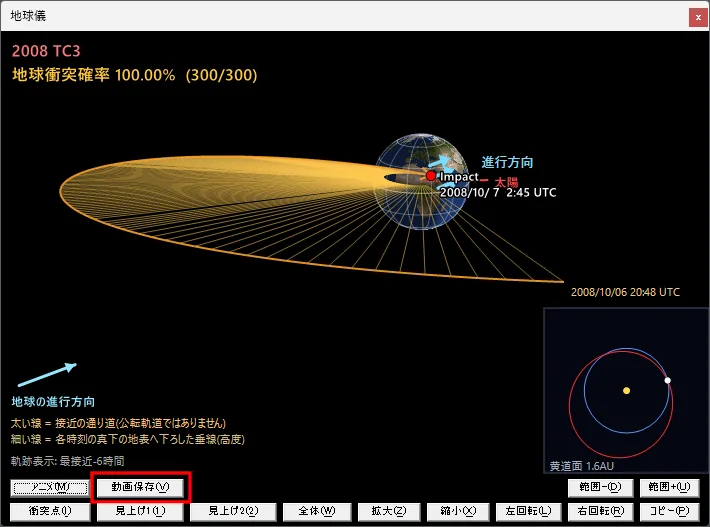
[Sky View 1] and [Sky View 2] bring the horizon into the frame, as if you were looking up at the sky. You can see the angle the entry came in at.
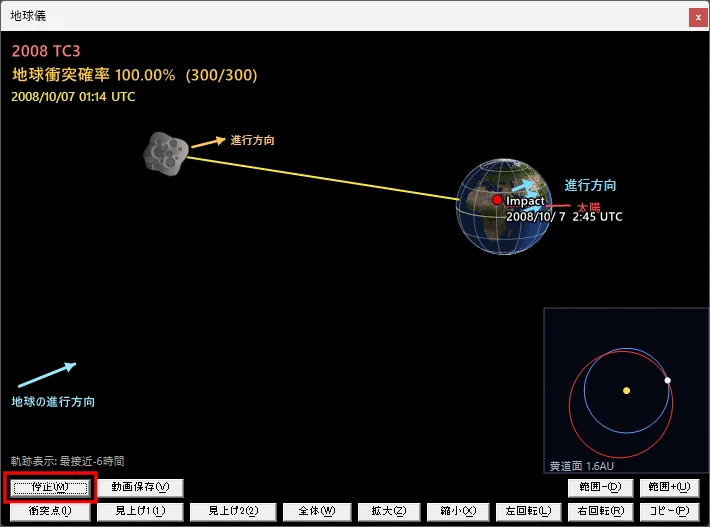
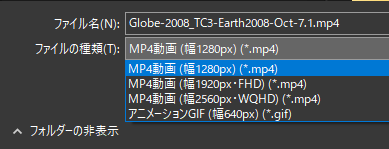
Press [Animate] to play back the asteroid closing in on the Earth. The time is shown on screen.
Why to the second — the integration step.
The [Calc Log] tab keeps a record of every integration step the nominal orbit used. It starts at 0.5 days, and as the object nears the Earth, the program refines the step on its own.
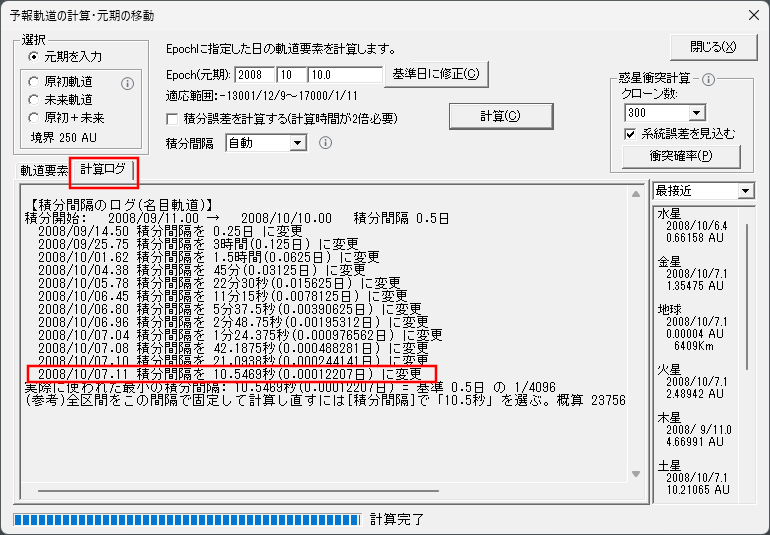
Impact detection itself looks at positions sampled at this interval — that is the “sampling interval 10.5 s” in §03. The time can be given to the second because the integration steps down that finely. To recompute the whole span with this step fixed, choose “10.5s” under [Step] (the screen also shows a rough estimate of the extra work).
Checking the answer.
2008 TC3 really did fall, so the computed values can be checked against the published ones. Chances like this do not come often.
| OrbitLife | Published | |
|---|---|---|
| Entry time (UTC) | 2008/10/7 2:45 | 2008/10/7 02:46 |
| Entry speed | 12.78 km/s | 12.8 km/s |
| Location | +21.007°, +30.294° | Nubian Desert, Sudan |
Being right once does not guarantee being right next time
2008 TC3 enjoyed extraordinarily favorable conditions: it was observed until 20 hours before impact. Run the same computation on an object years before it falls, with only a short observed arc, and the bundle of clones spreads far wide of the Earth, and the probability comes out as a small number. That is the normal case. The 100.00% means only that this is how it turned out for this object, with these observations. — The Final Call.
You can do the same computation for eleven more. As of May 2026, twelve asteroids have been found before they fell. All of their observations remain at the MPC, and OrbitLife can download them directly — Asteroids Found Before They Fell.
Next door.
Geocentric Orbit of a Minimoon
The same [Move Epoch of Solution] — used not for an impact, but for an object captured by the Earth.
→ MinimoonsAsteroids Found Before They Fell
All twelve. With the same procedure, you can compute the other eleven yourself.
→ The twelveThe Final Call
Numbers that agree are not the same as numbers that are right.
→ The Final CallAbout 2008 TC3.
The orbital elements, residuals, impact time, latitude and longitude, entry speed, impact probability and integration steps are all values computed with OrbitLife, exactly as shown on the screens above. The facts of the discovery and the fall are from the following.